
Categories: AI Customer Service, AI Shopping Assistant
BrowseBuddy Review: Is This AI Sales Assistant Worth It?

Let's be honest for a second. Running an e-commerce store is a grind. You spend ages perfecting your product photos, writing descriptions that would make Shakespeare weep, and fine-tuning your ad campaigns. Then, a customer lands on your site at 2 AM, has a simple question about shipping, gets no answer, and poof. They're gone. Forever. That's a sale that just evaporated into the digital ether.
I've been in the SEO and traffic game for years, and I've seen this happen a thousand times. We obsess over getting people to the store, but sometimes we drop the ball when they’re standing right in front of the digital cash register. It’s frustrating.
So, when I see a new tool pop up that claims to be a “generative AI solution for ecommerce merchants,” my professional skepticism kicks in. Hard. Another chatbot? Groundbreaking. But the name—BrowseBuddy—sounded friendly enough, so I decided to take a look. And I’ve gotta say, I'm more than a little intrigued.
What Exactly is BrowseBuddy, Anyway?
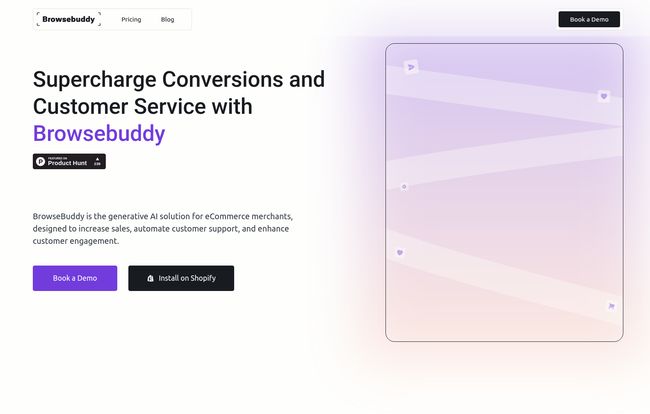
Okay, stripping away the marketing jargon, BrowseBuddy is an AI-powered chatbot you integrate into your store. But calling it just a chatbot feels like calling a Swiss Army knife just a knife. It’s designed to be a combination of a super-smart salesperson and an always-on customer support agent. Think of it as that one perfect retail employee you wish you could clone—the one who knows every product, anticipates customer needs, and never, ever needs a coffee break. Now, make it digital and plug it into your Shopify store.
It’s not just about answering “Where is my order?”. It’s about creating a conversation. A customer might say, “I’m looking for a waterproof jacket for hiking in the Pacific Northwest,” and instead of just showing a list of all jackets, BrowseBuddy is meant to ask follow-up questions, suggest specific products, and maybe even recommend the right pair of boots to go with it. It turns a static browsing session into a guided shopping experience. An adventure, as they put it.
The Core Features That Actually Matter
A feature list is just a list until you see how it translates into actual money in your pocket or time back in your day. Here's my breakdown of what BrowseBuddy brings to the table.
Your 24/7 Digital Sales Associate and Support Agent
This is the big one. Combining 24/7 Customer Support with a Digital Sales Associate means you stop bleeding sales overnight or when your support team is swamped. It’s a real-time resolution center. A potential customer has a question about materials at midnight? Handled. Someone's wondering about your return policy while you’re in a meeting? Handled. It’s your first line of defense, and offense, constantly on the clock. This alone can be a massive win for small to medium-sized stores struggling to provide round-the-clock service.
The Art of the Smart Suggestion
Now this is where things get interesting from a conversion rate optimization (CRO) perspective. Features like Smart Product Suggestions, AI-Powered Search, and being an Insightful Product Matchmaker are where the magic happens. We’ve all seen clunky, useless search bars. You type in “red shirt” and it shows you a blue hat. Useless.
BrowseBuddy aims to be smarter. It's designed to understand intent. It acts like a personal shopper, guiding visitors to products they'll actually love. This is how you increase your Average Order Value (AOV). A customer finds the perfect dress, and the bot chimes in with, “That looks great! Customers who bought this also loved these earrings to complete the look.” It's upselling, but in a way that feels genuinely helpful, not sleazy.
Visit Browsebuddy
A Smoother Path to Purchase
Let's talk about the dreaded cart abandonment. According to folks over at the Baymard Institute, the average cart abandonment rate is ridiculously high, something like 70%. A major reason is unexpected costs or a confusing checkout process. BrowseBuddy's Smart Checkout Companion feature is designed to tackle this head-on. It can proactively answer last-minute questions about shipping, clarify discount codes, or just provide that little nudge of reassurance a customer needs to click “Buy Now.” It’s like having a helpful friend there to hold their hand through the final step.
The Good, The Bad, and The AI-Powered
No tool is perfect. Let's get into the nitty-gritty. I’ve seen enough shiny objects in my career to know you have to look at the potential downsides, too.
Where BrowseBuddy Really Shines
The upside is pretty clear. You get enhanced customer engagement, which usually leads to higher conversions. You get automated support, which frees up you or your team to work on bigger-picture stuff. And it's all wrapped up with an easy Shopify integration. For a growing store, this could be the tool that lets you scale your customer service without having to hire three new people. The multilingual support is also a massive plus for anyone looking to sell internationally. That's a feature that used to cost a fortune to implement well.
Let's Be Real: The Potential Hiccups
Okay, let’s ground ourselves. First, there's the setup. It might be an “easy” integration, but any AI needs to be trained. Its effectiveness is completely dependent on the quality of your product catalog data. It's the classic GIGO principle: Garbage In, Garbage Out. If your product descriptions are lazy and your data is a mess, BrowseBuddy won't be a miracle worker. It will just be a well-meaning but confused robot. You have to put in the work to give it the right information.
And then there's the big philosophical debate: the human touch. Some people will always argue that relying on AI reduces genuine human interaction. They’re not entirely wrong. A bot can’t replicate true empathy. However, I’ve always felt that a fast, accurate answer from a bot is a million times better than a 12-hour wait for a slow answer from a human. The goal isn't to replace your human team for complex issues, but to handle the 80% of repetitive questions, freeing up your team for the conversations that really matter.
The Big Question: What Does BrowseBuddy Cost?
And now, the moment you’ve all been waiting for. The price tag. I went over to their pricing page, full of anticipation, and was met with… well, a beautifully designed but completely empty page. Classic.
As of this writing, BrowseBuddy's pricing isn't public. This usually points to one of two things: they're either still in a very early stage, or they've opted for a “Book a Demo” sales model. This is common for SaaS tools that require a bit of setup. It likely means pricing is customized based on your store’s traffic, catalog size, or specific needs. While I always prefer transparent pricing, this approach means you can get a plan that fits your exact situation. My advice? If you're serious, book the demo and get a direct quote. Don't let the lack of a public price scare you off if the features sound right.
Who is BrowseBuddy ACTUALLY For?
So, who should be booking that demo? If you're just starting out with a handful of products and a few orders a week, this is probably overkill. You can handle the customer DMs yourself. But if you're a Shopify store owner who is starting to feel the growing pains—if you're missing sales after hours, your support inbox is overflowing, and you want to proactively boost your AOV without being pushy—then you are the prime candidate for a tool like BrowseBuddy. It’s for the ambitious store that’s ready to scale its customer experience right alongside its traffic.
Answering Your Burning Questions (FAQ)
How easy is it to install BrowseBuddy on Shopify?
Based on their site, it's designed for a straightforward integration, likely through the Shopify App Store. Most modern apps have a pretty seamless setup process, but expect to spend some time configuring the AI with your product data for best results.
Can BrowseBuddy understand complex customer questions?
It's built on a generative AI model, which means it's much more capable than old-school, keyword-based bots. It should handle conversational queries well, but for highly specific or emotionally charged issues, you'll still want a human to take over.
Will using an AI chatbot feel impersonal to my customers?
It can, if implemented poorly. The key is to be transparent. Let customers know they're talking to an AI assistant that can quickly handle most requests, but also provide an easy way to escalate to a human. A good bot experience is better than a bad human one.
What kind of data do I need for the product recommendations to work well?
You'll need a clean, well-structured product catalog. This means detailed descriptions, high-quality images, accurate tags, and any relevant attributes (color, size, material, etc.). The more quality data the AI has to learn from, the smarter its recommendations will be.
Does BrowseBuddy support languages other than English?
Yes, multilingual support is one of its core features. This is a significant advantage for stores with an international customer base.
Is there a free trial for BrowseBuddy?
This isn't specified on their website. Given their demo-based model, a free trial might be offered after a sales call, or they may have a pilot program available. Your best bet is to ask during the demo.
My Final Take
So, is BrowseBuddy just another flash in the pan? I don't think so. The concept of an integrated AI sales and support agent isn’t new, but the execution and focus on a conversational, helpful experience feel like a step in the right direction. It's not a magic wand that will fix a bad business, but it could be a powerful lever for a good business that wants to grow.
It forces you to get your data in order (which you should do anyway!) and provides a scalable way to improve your customer experience and, most importantly, your bottom line. In an age where customer attention is the most valuable currency, having a buddy to help you out, 24/7, might just be the smartest investment you can make. It's a tool I'll definitely be keeping an eye on.


