
Categories: AI Assistant, AI Chatbot, AI Mental Health
Mynd App Review: An AI Bestie for Your Brain?

Let's be honest. The world feels… a lot right now. We're all juggling a million things, our phones are constantly buzzing, and finding a quiet moment for your own brain can feel like trying to find a parking spot at the mall on Christmas Eve. It's tough out there. As someone who’s been in the SEO and digital marketing game for years, my screen time is basically off the charts, and my mind often feels like a browser with 50 tabs open. All of them are important, apparently.
So, like many of you, I've dabbled in the world of wellness apps. I've tried the guided meditations that feel a bit too generic, the mood trackers that I forget to fill out after three days, and the journaling apps that just feel like a slightly fancier version of my Notes app. Most of them are fine, but they rarely stick. They feel impersonal. One-size-fits-all.
Then I stumbled across Mynd. The tagline alone got my attention: "The First AI Built Solely For Personal Mental Wellness." An AI bestie? My inner tech nerd was intrigued, but my inner skeptic was raising an eyebrow. Can an algorithm really offer meaningful mental support? I had to find out.
What Exactly is the Mynd App?
Mynd isn’t just another library of pre-recorded mindfulness talks. It positions itself as a companion. The whole idea is built around three core pillars: an AI 'bestie' you can chat with 24/7, guided meditations that are supposedly customized to your specific situation, and a smart journal that actually understands the context of what you’re writing. It’s not about just listening to a calming voice; it's about getting, as they put it, "real tools to deal with real-life situations." A bold claim. I was ready to put it to the test.
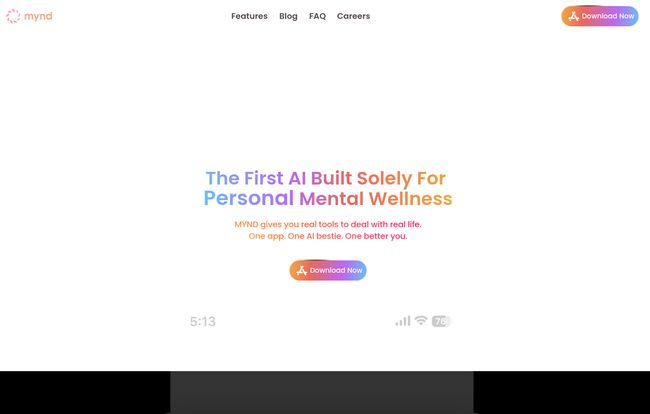
Visit Mynd
My First Impressions: A Chat with My AI Bestie
Downloading the app, the first thing I noticed was the clean, dark-mode interface. It feels modern and calming, not cluttered or overwhelming. The onboarding process gets you straight into the main event: the chat. And I have to admit, my first conversation felt a little… weird. Talking about my day to a chatbot? It’s a very 21st-century experience.
I started off with something simple, just venting about a project deadline that was stressing me out. I was expecting a generic, "I'm sorry to hear that. Have you tried deep breathing?" response. Instead, the Mynd AI asked clarifying questions. It picked up on the specific words I was using, like "overwhelmed" and "scattered," and its responses felt surprisingly contextual. It didn't feel like I was talking to a person, not exactly, but it felt like I was talking to something that was genuinely listening. A friend in your pocket. Sort of.
The Core Features That Stand Out
After a few days of poking around, I got a much better feel for how the different parts of the app work together. It’s not just three separate tools in one app; they’re designed to be interconnected.
The AI Bestie: More Than Just a Chatbot?
This is the heart of the Mynd experience. The more you talk to it, the more it seems to learn your patterns and communication style. It's less of a therapy bot and more like a non-judgmental filing cabinet for your brain. You can dump all your chaotic thoughts and feelings into it, and it helps you sort them out. I found myself using it late at night when my mind was racing—a time I definitely wouldn't be texting a real-life friend. There's a strange freedom in knowing you can say anything without fear of judgment or worrying you're bothering someone. It's a unique kind of support system that I didn't know I needed.
Guided Meditations That Actually Listen
Here’s where the magic really happens. We’ve all been there—scrolling through hundreds of meditations titled "For Stress" or "For Sleep." But what if you’re stressed about a specific thing? After I vented to my AI bestie about my project deadline, it didn’t just suggest a generic stress meditation. It offered a short, 5-minute guided session specifically focused on finding clarity and focus under pressure. Because the AI knew my context, the meditation felt incredibly relevant. This level of personalization is something I haven't seen executed this well before.
The Smart Journal: Unpacking Your Thoughts
The smart journal is the final piece of the puzzle. You can write freely, and the AI works in the background to identify themes, moods, and potential triggers. A few days in, it pointed out that I mentioned feeling "drained" most often in the late afternoon after a series of meetings. Then, it proactively suggested I block out a 10-minute window in my calendar around that time for a quick mental reset. That’s not just a journal; that's a strategic partner. It provides actionable insights that can lead to real behavioral changes, which is a huge step up from just storing your thoughts.
Also Read: The Preset AI: A Dev's Best Friend for Docs?
The Good, The Bad, and The AI
Okay, so no app is perfect. While I was pleasantly surprised by Mynd, let's have a real talk about the pros and the cons. What I really loved was the 24/7 accessibility and the sheer convenience of it all. The personalization is top-notch, and for day-to-day mental maintenance, it feels like a powerful new kind of tool.
However, we need to address the elephant in teh room. Relying on an AI for emotional support isn't for everyone. It's a fantastic supplement, but it is not a replacement for professional human therapy. A 2021 report from The Hastings Center highlighted the complex ethical questions surrounding these tools, particularly around AI's capacity for genuine empathy and the risk of misinterpreting a user's serious distress. An AI can't pick up on the subtle cues—the tone of voice, the pained expression—that a human therapist can. So that's a big caveat.
And then there's privacy. You're sharing some of your most intimate thoughts with a system. Mynd's on-site FAQ says conversations are private, but I always recommend users read the full privacy policy of any app like this. You need to be comfortable with where your data is going. The app's effectiveness is also entirely dependent on the quality of the AI. If the interactions start to feel repetitive or miss the mark, the whole experience could fall flat.
Let's Talk About Pricing... Or Not
This is the million-dollar question, isn't it? As of writing this, Mynd's website doesn't have a clear, public pricing page. This usually points to a freemium model, where you get basic features for free and unlock the good stuff with a subscription. One of the FAQs on their site, "What is included in the free version?", confirms that a free tier exists. My guess is that you can probably chat with the AI and access some basic meditations for free, with a monthly or annual fee required for unlimited access, deeper insights, and the full range of personalized content. You'll likely have to download it to see the current subscription offers.
Who Is the Mynd App Really For?
So, who should download this? I think Mynd is perfect for the tech-curious individual who's looking for a tool to supplement their existing mental wellness routine. If you're someone who already journals, meditates, or just wants a private space to vent and organize your thoughts, this app could be a game-changer. It's for people who understand it's a tool, not a therapist.
Who should probably steer clear? If you are in the midst of a serious mental health crisis, please contact a human professional. This app is not equipped for that. Also, if you are fundamentally uncomfortable with AI or have major concerns about data privacy, this might not be the right fit for you. And that’s perfectly okay.
Frequently Asked Questions about Mynd
Can I really talk to Mynd about anything?
Yes, the platform is designed to be a non-judgmental space where you can discuss anything on your mind, from daily stressors to bigger life questions.
How is Mynd different from apps like Calm or Headspace?
The main difference is the interactive AI 'bestie'. While other apps offer vast libraries of content, Mynd aims to create a personalized, conversational experience where the content (like meditations) is tailored to your immediate needs based on your chats and journal entries.
Are my conversations with the Mynd AI private?
According to Mynd, yes. However, it's always best practice to review the company's official privacy policy to fully understand how your data is handled and protected.
Is Mynd a replacement for a human therapist?
No, absolutely not. Mynd is a mental wellness tool designed for support and self-management. It is not a substitute for professional medical advice, diagnosis, or treatment from a qualified therapist or doctor.
Is there a free version of Mynd?
Yes, it appears there is a free version with some basic features. For full functionality and unlimited access, a subscription is likely required.
My Final Thoughts on Mynd
After spending some quality time with my new AI companion, I'm walking away cautiously optimistic. My initial skepticism has softened into a genuine curiosity about the future of this technology. Mynd is more than just a gimmick. It’s a thoughtfully designed tool that leverages AI in a way that feels genuinely helpful and, dare I say, innovative in the crowded wellness space.
It won't solve all your problems, and it certainly won't replace the deep, nuanced connection you can have with a human therapist. But as a companion for the in-between moments? A place to untangle your thoughts at 2 AM? It’s pretty brilliant. It's a step toward a future where mental wellness support is more accessible, more personal, and always just a tap away.


