
Categories: AI Article Summarizer, AI Papers
ReadSomethingSciency Review: Science Papers for Everyone?

Let's be real for a second. We've all been there. You click on a link to a fascinating study—maybe something about AI, behavioral economics, or the weirdness of quantum physics—and you’re immediately hit with a wall of text that looks like a different language. Jargon, complex equations, and sentences that feel a mile long. You close the tab, feeling a little less smart and a lot more frustrated.
It’s the great gatekeeping of our time. So much incredible knowledge is locked away in academic papers, accessible only to those with a PhD and a high tolerance for dry, dense prose. For years, I’ve been looking for a better way, a sort of Rosetta Stone for academic-speak. And I think I might have just stumbled upon somthing pretty close.
It's called ReadSomethingSciency. And it’s not just another content aggregator. It's a platform with a very specific, very ambitious goal: to unlock science for everyone. And I mean everyone.
So, What is ReadSomethingSciency, Anyway?
At its core, ReadSomethingSciency is an educational platform that takes seminal, often groundbreaking, scientific papers and... well, explains them. It curates a library of over 270 influential papers across more than 20 different fields—we're talking everything from Psychology and AI to Economics and even Parapsychology (yes, you read that right).
But here's the kicker, and the part that really got my attention. It doesn't just give you one generic summary. It breaks down each paper at three distinct levels of expertise:
- Beginner: For the casually curious. You don't need any prior knowledge.
- Intermediate: For students or enthusiasts who have some background in the field.
- Advanced: For professionals and experts who want to get straight to the meaty details.
This multi-tiered approach is, frankly, genius. It’s like a video game where you can select the difficulty level before you start. It tears down the biggest barrier to entry: the fear of not being smart enough.
The “Choose Your Own Adventure” Approach to Learning
I’ve always been a fan of tools that democratize information. The internet was supposed to do that, but sometimes it just gives us more hay to find the needle in. ReadSomethingSciency feels different. It's curated. It’s structured. It feels like it was built by someone who actually cares about the learning process.
Turns out, it was. The founder, Sylvain, mentions on the site that his academic journey led him to want to build a platform to simplify and explain these papers for everyone. You can feel that personal mission in the platform’s design. It’s clean, focused, and doesn't bombard you with a million distractions.
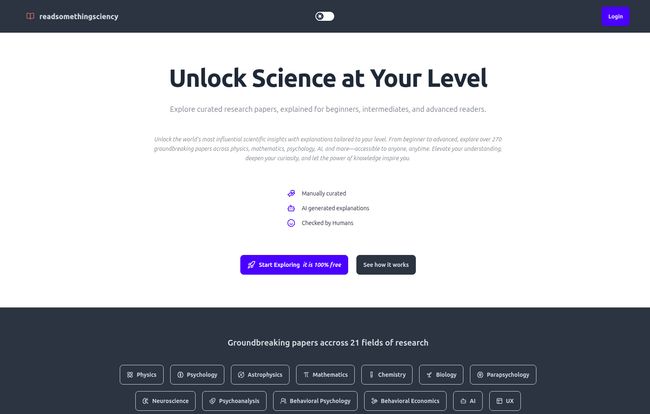
Visit ReadSomethingSciency
How it Works: A Smart Human-AI Partnership
Now, as an SEO and tech guy, I'm always a bit skeptical of AI-generated content. We've seen the good, the bad, and the very, very weird. ReadSomethingSciency uses AI to generate the initial explanations, which makes sense for handling this volume of complex material. But—and this is a big but—they don’t stop there. Each explanation is then checked by a human.
This hybrid model is the sweet spot. You get the scale and efficiency of AI, with the nuance, accuracy, and sanity check of a real human brain. It's a system designed to prevent those bizarre AI hallucinations from telling you that Einstein's theory of relativity is actually about a time-traveling hamster. It adds a layer of trust that’s often missing from purely AI-driven tools.
My Honest Take After Kicking the Tires
Alright, so I spent a good amount of time clicking around, reading papers I vaguely remembered from college and others I'd never heard of. I read about Kahneman and Tversky's work on cognitive biases as a beginner, and then jumped over to an advanced look at a paper on bioelectric networks. Here's my breakdown of the good, and the things to be aware of.
What I Genuinely Liked
First off, the accessibility is incredible. Being able to toggle between difficulty levels on the same paper is a game-changer. It means you can start with the basics to get your bearings, and then ramp up to the more complex ideas once you feel comfortable. For students, this is an absolute goldmine. For professionals like me, who often need to get up to speed on a topic outside their core expertise, it’s a massive time-saver.
The breadth of topics is also impressive. One minute you're reading about the foundations of General Relativity, the next you're exploring behavioral economics. The "learning tracks" feature, which strings related papers together into a coherent narrative, is a fantastic touch for anyone who wants a more structured learning path.
And let's not forget the best part: it's 100% free. In a world where every useful tool seems to be hiding behind a subscription wall, this is a breath of fresh air. There's an option to create an account, but the core functionality is right there.
A Few Things to Keep in Mind
No tool is perfect, right? One of the first things you'll notice is that you need to create an account to get the full experience. It's a small hurdle, but still a hurdle.
Also, while the human-in-the-loop system is great, it’s still wise to treat this as a starting point, not the final word. The goal here is to make science accessible, not to replace the original paper. If you're doing serious academic work, you'll still want to grapple with the primary source material. Think of ReadSomethingSciency as the brilliant tutor who preps you for the big exam.
Finally, I'd love a bit more transparency on the curation process. How are papers chosen? Who are the human checkers? Knowing more about the editorial standards would add even more credibility. But for a free platform, it's hard to complain too much. Even if some of the site pages were, shall we say, a bit buggy when I visited. (We've all been there, Sylvain!).
Who Is This Platform For?
I can see a few groups of people getting a ton of value from this:
- Students: High school and university students who need to understand core concepts without getting lost in the weeds.
- Lifelong Learners: Anyone who is just plain curious and wants to understand the world better.
- Professionals: People who need to stay informed about developments in adjacent fields. An AI developer could get a quick, smart primer on psychology, for instance.
- Content Creators and Journalists: A fantastic tool for background research and understanding the source material for an article or video.
Frequently Asked Questions
- 1. What exactly is ReadSomethingSciency?
- It's a free educational platform that provides curated, multi-level explanations for over 270 influential scientific papers across fields like physics, AI, psychology, and more, making them accessible to everyone.
- 2. Is ReadSomethingSciency really free to use?
- Yes, as of my review, the platform is 100% free. You may need to create an account to access all the features, but there's no subscription fee.
- 3. How does the platform ensure the explanations are accurate?
- It uses a hybrid model. The explanations are initially generated by AI and then reviewed and verified by humans to ensure accuracy and clarity.
- 4. What kinds of topics can I learn about?
- The library is quite diverse, covering more than 20 fields including physics, mathematics, psychology, AI, behavioral economics, neuroscience, and even philosophy.
- 5. Do I have to create an account?
- While you can browse some content without one, creating an account is required to get the full experience and access all the learning features on the platform.
- 6. Who is behind ReadSomethingSciency?
- The platform was founded by Sylvain Zinser, an academic who wanted to create a better way to make scientific knowledge accessible to a broader audience.
Final Thoughts: Is It Worth Your Time?
Absolutely. ReadSomethingSciency isn't trying to be a substitute for a formal education or deep, rigorous study. What it does, and does remarkably well, is act as a bridge. It bridges the gap between casual curiosity and dense academia. It’s an invitation to the conversation, a friendly guide that says, “Hey, this stuff is cool, and you’re smart enough to get it. Let me show you.”
In an internet cluttered with noise, a tool that champions clarity and understanding is something to celebrate. So go on, read something sciency. You might just surprise yourself.
References and Sources
- ReadSomethingSciency Official Website: https://readsomethingsciency.com/


